Best Workout Split: Full Body vs Upper/Lower vs PPL
Choose the best workout split by training days, recovery, and schedule. Compare full body, upper/lower, PPL, hybrid, and Arnold splits.
Quick answer: if you are comparing workout splits pros and cons, full body usually works best for 2-3 days per week, upper/lower for 4 days, and push pull legs (PPL) for 5-6. The best split is the one you can recover from, repeat long enough to progress, and still handle when a real week gets messy.
Most workout split debates are really schedule and recovery debates. If your week changes often, a simpler split usually beats the one that looks best in theory.
Updated Jun 7, 2026: adds clearer answers to the split questions lifters compare before choosing an app: push pull legs app, push pull legs vs upper/lower, full body vs push pull legs on 3 days, and what to do when missed workouts disrupt the rotation.
If you want to turn the comparison into a real plan, start with the workout split generator, the workout planner app guide, and the push/pull/legs overview.
Workout splits pros and cons: direct answer
For most lifters, full body is best for 2-3 training days, upper/lower is best for 4 days, and PPL is best for 5-6 days. The best split is the one you can run consistently, recover from, and progress on for months.
| Split | Best for | Days per week | Main tradeoff |
|---|---|---|---|
| Full body | Beginners, busy schedules, and consistency-first training. | 2-3 | Sessions can get long if you cram in too much accessory work. |
| Upper/lower | Most intermediate lifters who can train four days. | 4 | Missing one day can throw off weekly balance if the plan is rigid. |
| Push pull legs | Hypertrophy-focused lifters who can train most days. | 5-6 | Recovery and schedule consistency matter much more. |
| PPL + upper/lower | Lifters whose week moves between four and six sessions. | 4-6 | Volume can drift too high if you do not review the week. |
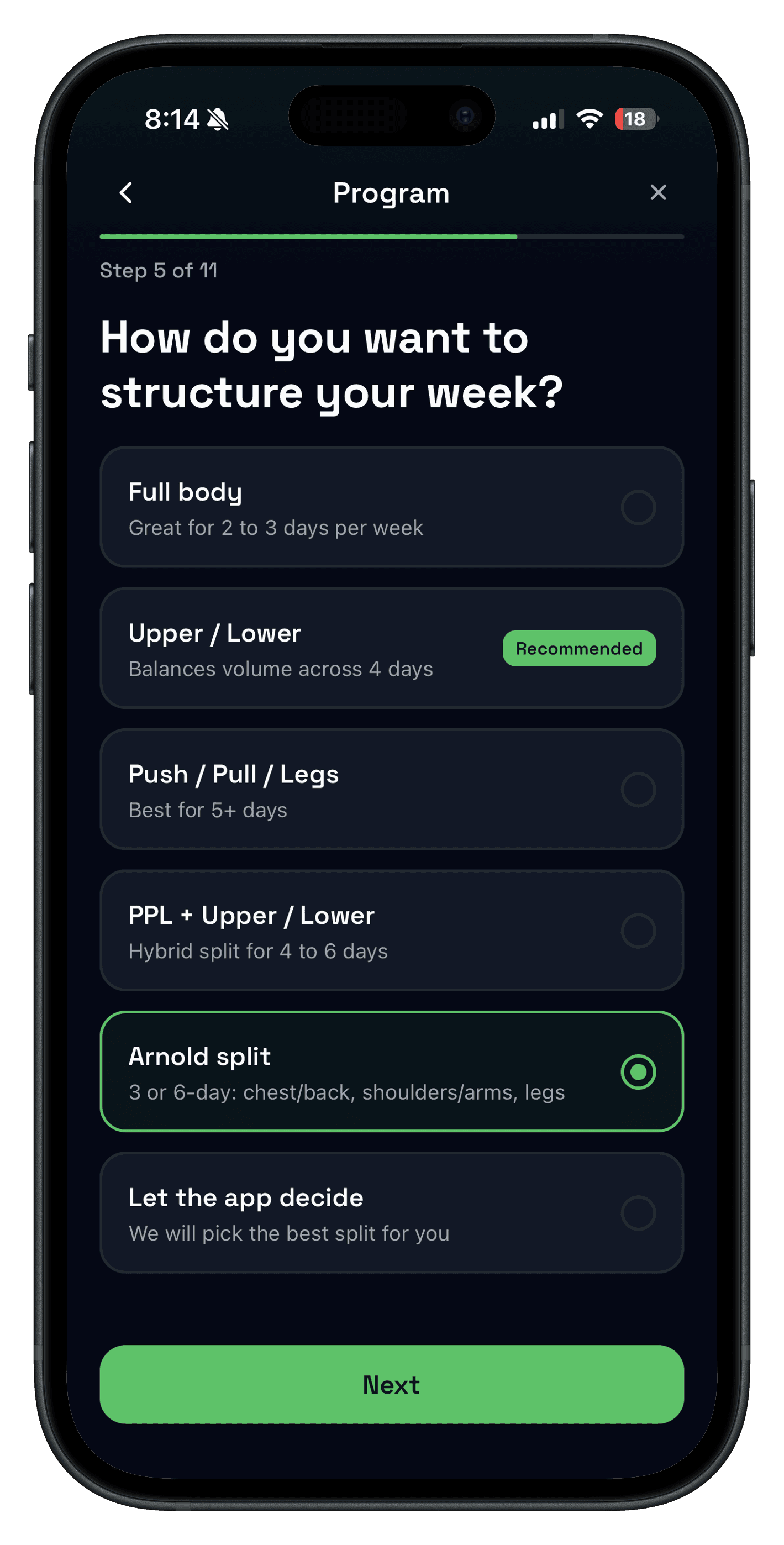
| Arnold split | Upper-body-biased bodybuilding training. | 3 or 6 | Leg frequency is lower unless you run the six-day version. |
Rule of thumb: if you want the best split on paper but cannot hit the weekly frequency, choose the simpler option instead.
Find your best workout split
Choose three basics. Get a practical weekly structure.
Which app is best for push pull legs or upper/lower splits?
If you search for a push pull legs app, decide whether you need a split recommendation, a PPL-specific tracker, or an upper/lower setup first. This guide helps you pick the split, then sends you to the page that matches the plan you actually want to run instead of forcing one page to do every job.
| If you want... | Best next page | Why |
|---|---|---|
| A push pull legs app for 3-, 5-, or 6-day PPL | Push Pull Legs app guide | Use the dedicated PPL page for schedule fit, templates, and progression flow. |
| The best upper/lower workout app for 4 days | Best Upper Lower Workout App | Use the dedicated upper/lower guide for four-workout template tests and recovery fit. |
| A schedule-first recommendation before you commit | Workout Split Generator | Use the generator if you are still deciding between full body, upper/lower, and PPL. |
| An editable AI-generated split | AI workout planner | Use the planner if you want a fast first draft before you start refining templates. |
Read the comparison here, then follow the page that matches your actual schedule. That keeps this hub focused on workout splits pros and cons while still giving dedicated split pages clearer internal support.
Full body vs upper/lower vs push pull legs: best split by training days
- 2-3 days/week: full body.
- 4 days/week: upper/lower.
- 5-6 days/week: push pull legs.
- 4-6 days/week: PPL + upper/lower.
- 3 or 6 days/week: Arnold split.
- Not sure: let the app decide.
You can make almost any split work if volume is realistic and recovery is good. The deciding factors are frequency, session length, and whether you actually show up for the plan.
If your plan keeps swinging from a perfect five-day week to a real four-day week, upper/lower or a hybrid usually beats forcing strict PPL.
If you already know you want a four-day setup, see Best Upper Lower Workout App. If you want a hypertrophy-first five- or six-day setup, compare this with Best Hypertrophy Workout Tracker App.
Best workout split for hypertrophy, strength, and busy schedules
| Goal | Best default split | Why |
|---|---|---|
| Build muscle on 3 days | Full body | You train every major pattern often enough without needing extra weekly sessions. |
| Build muscle on 4 days | Upper/lower | It is usually the cleanest balance of weekly volume, recovery, and schedule fit. |
| Build muscle on 5-6 days | Push pull legs | More session separation makes it easier to push hypertrophy volume when recovery is solid. |
| Get stronger with a busy schedule | Full body or upper/lower | Both keep the main lifts frequent without relying on a perfect week. |
| Prefer a bodybuilding-style upper-body bias | Arnold split | It gives chest/back and shoulders/arms more focused attention, with a leg-frequency tradeoff. |
If you want the app workflow behind those choices, pair this comparison with Best Upper Lower Workout App, Best Hypertrophy Workout Tracker App, and the workout split generator.
Full body vs push pull legs on 3 days: which is better for hypertrophy?
For most lifters training three days per week, full body is better than trying to force a strict push pull legs rotation. Full body lets you hit the main lifts more often each week, keeps the plan easier to recover from, and stays cleaner when a session gets bumped.
If you only have three reliable sessions per week, full body is usually the better hypertrophy split. A three-day PPL can still work if you simply enjoy the split and keep the rotation moving forward, but it is usually slower to repeat each movement pattern.
| If you train 3 days... | Usually better | Why |
|---|---|---|
| You want the safest hypertrophy default | Full body | You hit each lift or muscle pattern more often without stretching the rotation across two weeks. |
| You care more about day-by-day specialization | Three-day PPL can work | It is workable if you keep the sequence rolling and accept slower frequency per muscle group. |
| You miss sessions often | Full body | It is much easier to stay balanced after a missed workout. |
If you still prefer the feel of PPL, use the push pull legs app page for setup ideas and keep the rotation continuous rather than resetting the week. If you want the simpler default, pair full body with a realistic weekly training frequency.
Push pull legs vs upper/lower split: pros and cons
Push pull legs vs upper/lower is usually a tradeoff between specialization and schedule resilience. Upper/lower is usually the better default if you train four days per week, want a cleaner recovery pattern, or occasionally miss sessions. PPL is usually better if you train five or six days, want more session specialization, and recover well from higher weekly volume.
- Choose upper/lower if your schedule is stable at four days and you want the simplest strong default.
- Choose PPL if you can train 5-6 days and want more hypertrophy-focused session separation.
- If your schedule swings between the two, use a hybrid instead of forcing one extreme.
For hypertrophy, upper/lower is usually the stronger default on four days, while PPL usually wins once you can reliably protect five or six. If you only train three days, neither strict upper/lower nor strict PPL is usually the best answer; full body is cleaner.
That is why many lifters land on a hybrid plan first, then narrow into stricter upper/lower or PPL once they know what their real week looks like.
Upper/lower vs push pull legs for beginners and intermediate lifters
For most beginners, strict push pull legs is usually less useful than a simpler split. Full body is the cleanest three-day default, and upper/lower is usually the better four-day default. For many intermediate lifters, the decision becomes easier: choose upper/lower if you want the strongest four-day balance, and choose PPL if you can really protect five or six weekly sessions and want more specialization.
- Beginner: full body on 3 days or upper/lower on 4 days.
- Intermediate with 4 days: upper/lower is usually the best default.
- Intermediate with 5-6 days: PPL becomes more attractive if recovery is solid.
The trap is choosing PPL too early because it feels more advanced. More specialization only helps when your schedule and recovery can support it. If you want the cleanest four-day app flow, see Best Upper Lower Workout App. If you know you want five or six training days, compare it with the hypertrophy PPL tracker guide.
Full body split: pros and cons (2-3 days/week)
Full body means you train all major muscle groups in each session. It is simple, efficient, and ideal if you train two or three days per week.
- Great for beginners and busy schedules.
- Frequent practice on key lifts.
- Less planning overhead and fewer missed muscles.
- Sessions can feel longer if you add too many accessories.
- Advanced lifters may want more per-muscle volume.
Best for: beginners, busy professionals, or anyone prioritizing consistency over volume.
For most lifters, full body is the best 3-day workout split because it lets you practice the main lifts often enough to progress without pretending you have a six-day schedule.
If your biggest challenge is just getting consistent again, pair a full-body plan with a realistic weekly training frequency.
Upper/lower split: pros and cons (4 days/week)
Upper/lower alternates upper body and lower body days. It balances recovery and volume and is a strong default for intermediate lifters training four days per week.
- Easy to recover between sessions.
- Higher volume per muscle without marathon sessions.
- Flexible scheduling (Mon/Tue/Thu/Fri or any 2+2 split).
- Missing a day can throw off the weekly balance.
- Leg days can feel heavy if recovery habits are poor.
Best for: intermediate lifters, strength + hypertrophy mix, anyone who can train four days consistently.
This is usually the safest recommendation when someone asks for the best workout split without any extra context, because it balances progression, flexibility, and recovery better than most alternatives.
Push pull legs: pros and cons (5-6 days/week)
PPL separates pushing muscles, pulling muscles, and legs. It is popular because it supports higher volume and clearer focus, but it requires more weekly sessions.
- High volume per muscle group.
- Clear focus each day and simple workout flow.
- Great for hypertrophy and accessory work.
- Needs 5-6 training days to be effective.
- Recovery can be challenging if sleep or nutrition is inconsistent.
Best for: advanced lifters or anyone who loves training most days of the week.
If you already know this is your preferred structure, use the push pull legs app page for the product workflow and the hypertrophy tracker guide for a PPL-specific app comparison.
PPL + upper/lower hybrid split: pros and cons (4-6 days/week)
This hybrid blends the structure of PPL with the recovery balance of upper/lower. It is useful if you want more weekly volume but your schedule varies between four and six days.
- More volume than a strict 4-day upper/lower plan.
- Flexible when your schedule changes week to week.
- Balanced push and pull exposure with clear lower-body focus.
- Requires more planning to keep weekly volume balanced.
- Can feel complicated if you prefer a simple routine.
Best for: lifters who want a hybrid approach or who train 4-6 days and want flexibility without losing structure.
Hybrid splits are often the best answer for people who want more than a simple four-day plan but cannot guarantee a perfect six-day week. That is where the planning workflow matters more than the split name.
Arnold split: pros and cons (3 or 6 days/week)
The Arnold split is a classic: chest/back, shoulders/arms, and legs. It can be run three days per week or repeated as a six-day cycle.
- High upper-body volume and clear focus each session.
- Great for aesthetics and muscle balance work.
- Simple to repeat as a 3-day or 6-day routine.
- Legs get less weekly frequency unless you run the 6-day version.
- Upper-body fatigue can build up without good recovery.
Best for: lifters who enjoy focused upper-body sessions and want a classic bodybuilding split.
Arnold is rarely the best starting point for a busy or inconsistent lifter. It is better as a deliberate choice for bodybuilding-style training than as a generic answer to "what split should I run?"
What workout split should you use if you miss workouts often?
If you miss workouts often, choose full body or upper/lower. Those splits are easier to rebalance after a missed day and less likely to leave one muscle group behind for the week.
- Miss 1 workout every few weeks: upper/lower is still fine.
- Miss workouts most weeks: full body is usually the safer choice.
- Only choose PPL if you can reliably protect 5-6 training days.
What should you do if you miss a workout on push pull legs or upper/lower?
Do not restart the whole week and do not try to cram the missed session into the next 48 hours just to stay on the calendar. The cleaner move is usually to roll the split forward and do the next workout type when you train again. That keeps fatigue, exercise order, and progression cleaner than forcing two lower days or two hard pull sessions back to back.
| If you miss... | Best next move | Why it works |
|---|---|---|
| A full-body day | Do the next full-body session when you return. | Full body is already resilient because each session covers the main patterns. |
| An upper/lower day | Resume with the missed upper or lower session, then continue the rotation. | You keep weekly balance without forcing a rushed catch-up session. |
| A push, pull, or legs day | Run the next session in the sequence when you return, and reassess if this happens often. | PPL works best when the sequence keeps rolling, not when you keep rebuilding the week. |
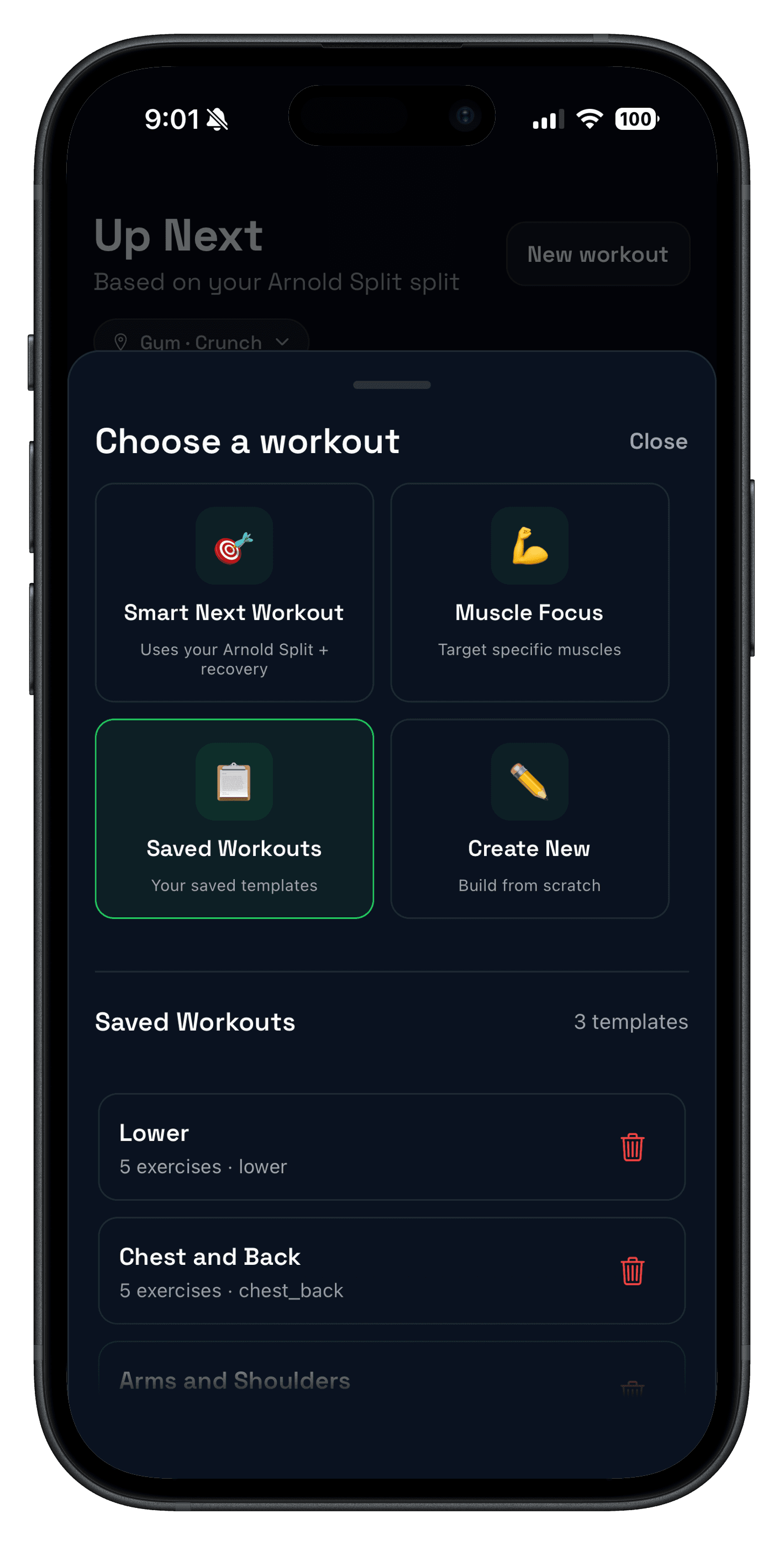
This is where a schedule-first tool helps. The workout split generator can steer you toward a more resilient split, and Up Next recommendations are built around recent training, recovery, and your saved templates so the next session stays obvious after a disrupted week.
Can a workout app auto-rotate skipped PPL workouts?
A good workout app should not punish you for missing Tuesday's pull day. It should either roll the next PPL workout forward or recommend the next session from recent training history and recovery instead of locking you to a fixed calendar slot. Push/Pull's Up Next recommendations use saved templates, recent workouts, and recovery signals so a disrupted week is easier to restart without rebuilding the plan.
How to switch workout splits without losing progress
- Keep your main lifts or close variations when possible.
- Keep weekly volume close to what you can actually recover from.
- Run the new split for at least 4-6 weeks before judging it.
- Track one or two main lifts so you can see whether the new structure is working.
The split is only the container. Consistency, progressive overload, and recovery create the results. If you need the template side of that system, pair this guide with Workout Template.
FAQ
What is the best workout split?
What is the best 3-day workout split?
Is upper/lower better than full body?
Is push pull legs better than upper/lower for hypertrophy?
Is full body or push pull legs better for 3 days?
Should beginners do upper/lower or push pull legs?
What workout split should I use if I miss workouts often?
What should I do if I miss a workout on push pull legs or upper/lower?
Can a workout app auto-rotate skipped push pull legs workouts?
What are the pros and cons of the Arnold split?
Can I switch workout splits without losing progress?
Ready to run the split you will actually keep?
Push/Pull includes templates for full body, upper/lower, push pull legs, PPL + upper/lower, and Arnold split, plus a split generator that helps you choose based on your real schedule.