
1RM Calculator: How to Estimate Your One-Rep Max (and Use It to Train Smarter)
A practical 1RM calculator guide: estimate your one-rep max from reps, understand accuracy, and use e1RM to set loads and track strength.

A 1RM calculator estimates your one-rep max from a submax set like 185 × 5. That estimate (often called e1RM) is one of the simplest ways to choose training weights and track strength without testing a true max.
This guide shows you the most useful formulas, the rep ranges where they tend to be most reliable, and a simple way to use e1RM for programming and progressive overload tracking.
Interactive Tool
1RM / e1RM Calculator
Estimate your one-rep max from a submax set, compare formulas, and build a training max you can actually use.
Estimated 1RM
215 lb
Epley formula based on 185 × 5
Training max
195 lb
90% of e1RM for more stable programming
Percent of 1RM table
Rounded to gym-friendly loadsUse this number in real training
- Build your ramp with the warm-up set calculator.
- Pair percentages with RIR/RPE targets when fatigue is high.
- Keep weekly top sets in a workout log so e1RM trends are comparable.
Updated Feb 2026 • Written by the Push/Pull team
Your 1RM (one-rep max) is the most weight you can lift for one clean rep. An estimated 1RM (e1RM) uses a set of multiple reps to predict what that single might be.
Quick answer: the simplest 1RM calculator workflow
- Pick one “top set” you can repeat weekly (usually 3-6 reps).
- Keep effort consistent using an RIR target (often ~1-2 reps in reserve).
- Estimate e1RM with one formula and stick to it.
- Use ~90% of e1RM as a conservative training max for percentages.
- Track the e1RM trend, not a single day’s number.
If effort targets are new, start with RIR and RPE explained. For safer heavy training, pair this with a consistent warm-up set ramp or use the warm-up set calculator.
What is an estimated 1RM (e1RM) good for?
A true 1RM test can be useful, but most training weeks do not need it. e1RM is useful because it converts different rep performances into one number you can trend over time.
- Programming: pick rough working loads using percentages of a training max.
- Progress tracking: see if strength is moving even when weekly rep targets change.
- Fatigue detection: spot when your “same effort” sets produce lower e1RM for multiple sessions.
1RM calculator formulas (Epley and Brzycki)
Most 1RM calculators use a simple equation based on weight and reps. The exact formula matters less than using one consistently.
| Formula | Estimated 1RM |
|---|---|
| Epley | weight × (1 + reps/30) |
| Brzycki | weight × 36 / (37 − reps) |
Use the same formula for the same lift every time. Trend consistency is more important than chasing a “perfect” number.
How accurate are 1RM calculators?
Accuracy depends on rep range, exercise, and how close the set is to failure. In general, estimates are more stable when reps are moderate and technique is consistent.
| Rep range | Best use | Note |
|---|---|---|
| 1-2 reps | Testing or near-testing | High fatigue and skill demand; not needed often. |
| 3-6 reps | Best default for e1RM | Usually a good balance of load and repeatability. |
| 7-10 reps | Acceptable for many lifts | Estimates can drift more if conditioning varies. |
| 11+ reps | Hypertrophy work | More influenced by endurance and pacing than max strength. |
If your sets are inconsistent, tighten rest and effort first. Your rest between sets and your RIR target will often change e1RM more than the formula.
How to use e1RM for training loads (without overthinking)
The cleanest approach is to set a conservative training max and base percentages on that number. This keeps weekly loads realistic and makes progressive overload easier to apply.
- Estimate e1RM from your weekly top set.
- Set training max ≈ 85-95% of e1RM (conservative is fine).
- Pick working sets by percentage, then adjust by RIR (effort beats math).
For a bigger-picture progression framework, read progressive overload explained. If e1RM is flat for multiple weeks, use the troubleshooting system in how to break a strength plateau.
Track strength trends without max testing
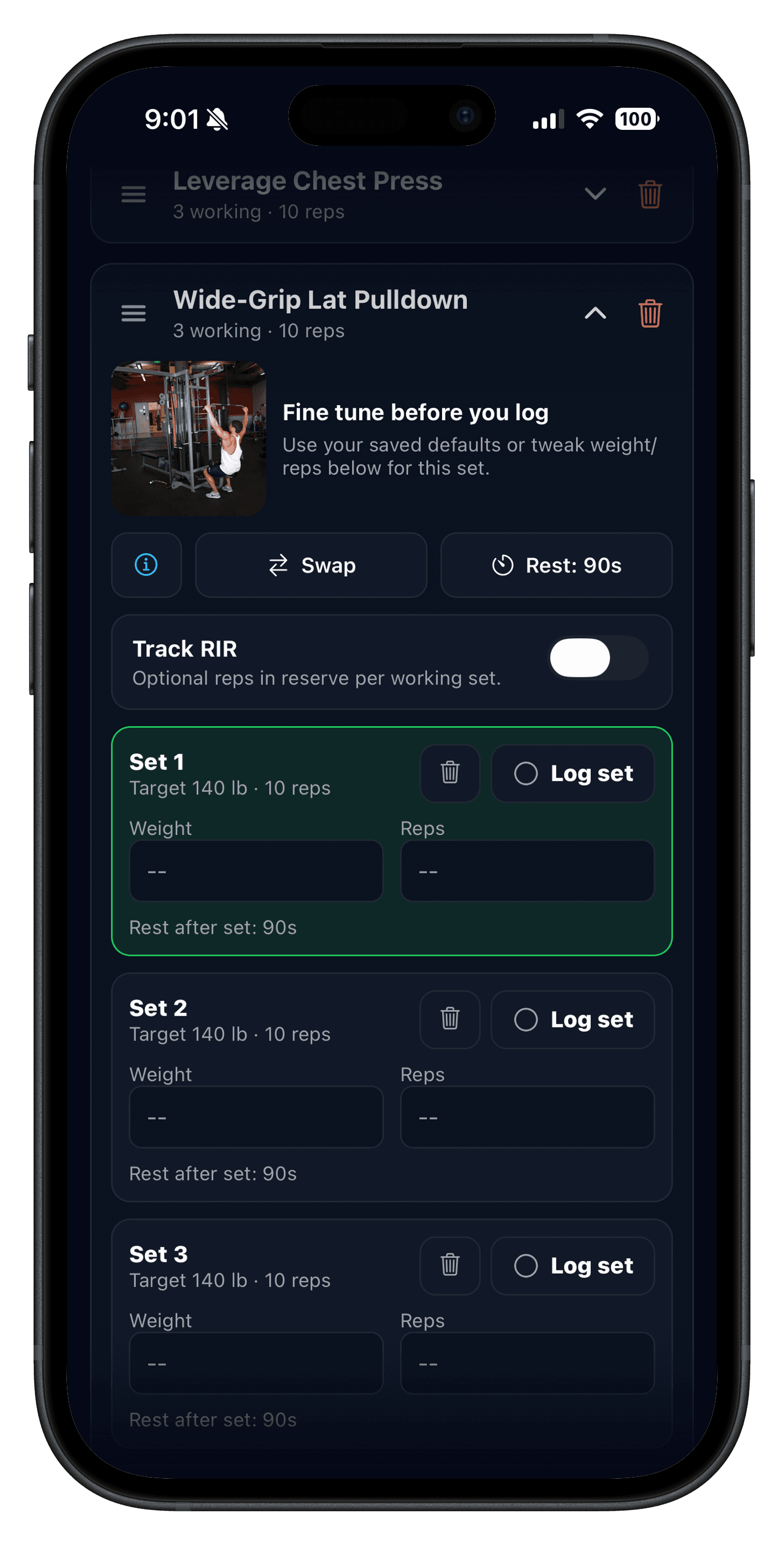
If you log one consistent top set each week, your strength trend becomes obvious. Push/Pull keeps your recent sets visible, so you can repeat a lift setup and progress with less guesswork.
How to track estimated 1RM in your workout log
You do not need a special calculator feature to benefit from e1RM. You just need a consistent logging habit for one “signal set” per lift.
- Choose a top set: for example, one set of 3-6 reps on squat and bench each week.
- Log effort: use RIR so “same reps” actually means the same difficulty.
- Estimate and note: calculate e1RM once and add it as a quick note (or track it in a separate sheet).
- Review weekly: if e1RM is trending up, keep the plan stable and progress slowly.
If you want a minimalist logging system that supports this, start with Workout Log: track sets, reps, and weight and the strength training tracker workflow.
Common mistakes that wreck e1RM accuracy
- Changing rep targets every week and expecting the estimate to be perfectly comparable.
- Letting rest times shrink on heavy sets (your reps become conditioning-limited).
- Logging inconsistent effort (one week at 0 RIR, next week at 3 RIR).
- Counting ugly reps the same as clean reps (form quality matters).
FAQ
What is a 1RM calculator?
A 1RM calculator estimates your one-rep max from a set of multiple reps. It is useful for selecting training weights and tracking strength trends without doing a true max attempt.
How accurate are 1RM calculators?
They are usually most reliable for moderate rep ranges (often around 3-10) when effort and technique are consistent. High-rep sets and changing rest times can make estimates drift.
What is the best 1RM formula?
There is no single best formula for everyone. Epley and Brzycki are both common; pick one and apply it consistently so your trend stays comparable.
Should beginners test a true 1RM?
Most beginners do not need to. A clean estimated 1RM from a moderate top set is usually safer and gives enough accuracy for programming.
What rep range should I use to estimate 1RM?
A top set of 3-6 reps is a great default. Many lifters can also estimate reasonably up to about 10 reps, but error often increases as reps climb.
What is a training max?
A training max is a conservative number you base your percentages on (often 85-95% of your estimated 1RM). It helps keep loads realistic so progress is steadier and form stays clean.
How do I use e1RM to program strength work?
Base percentages on a training max, then use RIR to keep effort consistent. If e1RM trends up over weeks, keep your plan stable; if it trends down alongside rising fatigue, consider adjusting volume or taking a deload week.
How do I track estimated 1RM in my workout log?
Log one repeatable top set each week (weight, reps, and effort), estimate e1RM with one formula, and compare the trend over time. Consistency in the lift setup matters more than the exact equation.
Related reading
A cleaner way to run the same progression system
Push/Pull is a fast workout log that keeps your last sets visible, supports templates for any split, and makes it easy to repeat a lift setup week to week.