
How Long to Rest Between Sets for Strength and Hypertrophy
Practical rest-between-sets guidelines for strength and hypertrophy, including 5-8 rep sets, compounds vs isolations, and how to keep progression honest.
If you are asking how long to rest between sets, use this quick rule: 2-5 minutes for heavy compound lifts, 1:30-3:00 for most hypertrophy work, and 45-90 seconds for many isolation sets when rep quality stays high.
For most lifters, the best rest time is the shortest interval that still lets the next set look like the set you planned. Too little rest turns strength work into conditioning. Too much rest can drag the session out without adding useful performance.
Updated May 16, 2026: adds clearer rest guidelines for strength work, hypertrophy training, and hard sets in the 5-8 rep range.
If you also want to keep rest consistent in the gym, pair this guide with rest timer controls, workout log basics, and RIR and RPE.
How long should you rest between sets for strength and hypertrophy?
Start with longer rest on big lifts and shorter rest on smaller lifts, then add 30-60 seconds only when reps, bar speed, or technique clearly fall off.
| Set type | Best starting rest | When to add time |
|---|---|---|
| Heavy compounds for strength | 2:00 to 5:00 | Add 30-60 seconds if reps, setup quality, or bar speed fall off too fast. |
| Most compound hypertrophy work | 1:30 to 3:00 | Go longer when the load is heavy or you are training near failure. |
| Isolation lifts | 0:45 to 1:30 | Add time if target reps or technique stop holding up. |
| Most 5-8 rep sets | 2:00 to 3:30 | Treat this as the default for hard compounds unless the lift is very light or very easy. |
That is usually enough precision. You do not need a different rule for every exercise. You need a starting range, a reason to adjust it, and a way to keep the rest time consistent enough that your progress is easy to judge.
Why rest time matters (more than you think)
Most people treat rest like dead time. It is not. Rest is part of the stimulus. The goal is not “rest as little as possible.” The goal is “rest enough to perform the next set the way you intended.”
- Performance: more rest usually means more reps and better technique on the next set.
- Volume quality: if your later sets fall apart, your “planned” volume is not the volume you actually trained.
- Progress clarity: consistent rest makes your numbers comparable, so you can tell if you are improving.
Two lifters can do the same workout on paper and get wildly different results depending on rest. If one person rests 60 seconds on a heavy squat day and the other rests 3 minutes, the second lifter will usually get more reps with cleaner form. That difference shows up over weeks as stronger overload signals.
What the research and guidelines suggest
You do not need to memorize studies to use rest intervals well, but it helps to know the direction of the evidence:
- Longer rests support strength. Meta-analyses and coaching practice consistently show that resting ~2-5 minutes between hard sets of compound lifts helps you maintain performance (reps, bar speed, technique), which translates to better strength gains over time.
- Hypertrophy can work with shorter rests, but volume matters. If you rest too short, you may lose reps and total volume. Longer rests often allow more high-quality work, which is a common reason they can match or outperform short rests for muscle growth in real-world training.
- Physiology backs the ranges. For high-effort sets, phosphocreatine (PCr) recovery is substantial by ~2 minutes and closer to complete by ~3-5 minutes, which is one reason heavy work feels better with longer rest.
- Guidelines align with practice. Common strength and conditioning guidance (including ACSM-style recommendations) tends to land around 2-3 minutes for strength work, ~1-2 minutes for hypertrophy work, and shorter intervals for muscular endurance/circuit-style training.
Translation: if your goal is strength, do not be afraid of longer rests. If your goal is hypertrophy, you can use moderate rests, but do not sacrifice set quality and total volume just to “feel the burn.”
- Research reviews (including work by Schoenfeld/Grgic and colleagues) generally find longer rests (2+ minutes) help preserve performance and tend to be better for strength outcomes.
- For hypertrophy, short rests can work if you still get enough hard sets, but in practice longer rests often make it easier to accumulate more high-quality volume.
- PCr recovery is a good mental model: roughly ~80-90% restored by ~2 minutes and closer to complete by ~3-5 minutes after a hard set, which maps well to heavy compound rest needs.
How long should you rest between sets?
Here are ranges that work for most lifters. Treat them like presets, not laws. Rest times vary by exercise, goal, fitness level, and even the day. If your next set is clearly underpowered, rest more. If you are scrolling your phone for five minutes between cable curls, rest less.
Rest: 2 to 5 minutes
Use longer rests on squats, bench, deadlifts, rows, and overhead press—especially when sets are 3-8 reps and technique matters. If you are consistently missing reps you “should” get, add time first.
Rest: 60 to 180 seconds
Compounds often like 90-180 seconds; isolations often feel great at 60-120 seconds. If your reps drop off hard, you are resting too short for the load you chose.
Rest: 20 to 90 seconds
Short rests make sense when the goal is density and conditioning. The tradeoff is you will likely lift lighter weights and your strength work will suffer if you apply this everywhere.
Rest: 45 to 90 seconds (accessories), 90 to 180 seconds (main lift)
Keep your main lift honest with enough rest, then compress accessories with shorter rests or supersets.
How long should you rest between sets for 5-8 reps?
For most compounds in the 5-8 rep range, start at about 2:00 to 3:30. That rep range is heavy enough that short rest often creates fake plateaus, but it usually does not need the full five minutes some near-max strength work deserves.
- Barbell compounds: start around 2:00-3:30.
- Machines and secondary compounds: start around 1:30-2:30.
- Very hard sets: add 30-60 seconds if your next set would lose reps or technique.
If you train close to failure, use the longer end of the range. If the lift is lighter, more stable, or more technical fatigue is low, you can often stay near the shorter end. The right test is simple: does the next set still look like the set you intended to train?
Pros and cons of different rest lengths
Most “rest debates” are really tradeoffs. Pick the one that matches your goal for that block.
- Pros: better rep quality, better strength performance, better technique on compounds, easier to keep load heavy.
- Cons: sessions take longer, you may lose focus, and it is easier to drift into “over-resting” on simple movements.
- Pros: great for time efficiency, pumps, conditioning, and accessory density.
- Cons: performance drops faster, loads tend to fall, technique can degrade on compounds, and strength progress can slow if you apply short rests everywhere.
Rest times by goal
Your goal determines the tradeoff you want: maximum performance (strength), more total quality volume (hypertrophy), or more density/conditioning (endurance and fat-loss-focused training).
- Main compounds: 2:30 to 5:00
- Secondary compounds: 2:00 to 3:30
- Accessories: 1:00 to 2:00
Strength is sensitive to fatigue. Longer rests help keep bar speed, technique, and confidence consistent.
- Big lifts in moderate rep ranges: 1:30 to 3:00
- Machines and accessories: 1:00 to 2:00
- Isolations: 0:45 to 1:30
Muscle growth cares about hard sets and total work over time. Rest enough to keep reps honest and volume high.
Fat loss comes from diet and total activity, not “short rests.” Keep rest long enough on your main lifts to maintain performance (often 2-4 minutes), then shorten accessory rest or use supersets if you need to save time.
Conditioning sessions can use shorter rests by design. Just do not confuse a conditioning day with a strength day. The intent is different, so the rest should be different.
Rest times by exercise (compounds vs isolations)
The same rest interval can be perfect for one exercise and terrible for another. A heavy barbell squat taxes you differently than a cable lateral raise.
Start at 2:00 to 3:30. If reps drop more than you expect from set to set, add 30-60 seconds. If your breathing is still chaotic or technique feels shaky, rest longer.
Start at 1:15 to 2:30. Machines are often easier to repeat under fatigue, but heavy sets still need time.
Start at 0:45 to 1:30. Shorter rests can work well here, as long as you can still hit your target reps with clean form.
One more pattern that surprises people: lower body compounds often need more rest than upper body compounds because they create more systemic fatigue (breathing and heart rate spike, bracing demand, bigger total muscle mass involved). If in doubt, give legs the longer end of the range.
Rest until you feel ready… then stick to a time
Here is the real-world answer most lifters need: rest times vary, and you should rest until you feel ready for the next set. But you also want consistency so your log is meaningful.
- Pick a default timer for the exercise (example: 3:00 for squat, 1:30 for curls).
- When the timer ends, ask: “Can I hit my target reps with the same technique and effort?”
- If yes, go. If not, take +30 to +60 seconds and reassess.
- Keep the default rest time the same for the whole block (2-4 weeks) so your sessions are comparable.
This keeps you honest in two ways: you do not rush sets that deserve more rest, and you do not accidentally turn accessories into five-minute breaks.
How to tell you are “ready” for the next set
Readiness is not mystical. It is mostly breathing, coordination, and confidence returning to baseline.
- You can breathe through your nose again, or your breathing is controlled.
- Your setup feels stable (bracing, foot pressure, bar path confidence).
- You can picture the next set going well, not surviving it.
- Your last set did not force sloppy reps you did not plan for.
If you track effort with RIR/RPE, readiness is even easier: if the same weight suddenly feels like it costs 2-3 extra reps of effort, you may need more rest (or a lighter day).
Warm-up sets: shorter is usually fine
Warm-ups are about practice and readiness, not fatigue. Most people can use shorter rests on warm-up sets (often 30-90 seconds). As the warm-up weight gets closer to your working weight, increase rest so your first work set is not accidentally under-recovered.
Rest short early, rest longer near the top. Your last warm-up should feel like a confident rehearsal, not a mini work set.
Common mistakes (and fast fixes)
If your form degrades or you are missing reps early, add 30-60 seconds. You will often get more total reps across the workout, which matters more than “finishing faster.”
Short rests create fatigue fast. That can be useful for conditioning or certain accessory blocks, but it is usually a poor default for heavy squats, presses, and rows.
Random rest makes progress look random. Set a default rest time per exercise and keep it steady for at least 2-4 weeks.
Short rests are fine for accessory work, but if you cannot hit your planned reps, shorten the exercise list—not the rest time.
If you miss reps, do not instantly “fix it” by resting 3 extra minutes. Try a simple order: (1) rest 30-60 seconds longer, (2) reduce load slightly, (3) reduce the number of hard sets for the day.
FAQ
Frequently asked questions
Quick answers for the situations that actually come up in the gym. Open one, get the rule, keep lifting.
How long should I rest between sets for hypertrophy?
Most lifters do well with about 1:30-3:00 for compound hypertrophy work and about 0:45-1:30 for many isolation lifts. If reps or technique drop harder than expected, rest longer.
How long should I rest between sets for 5-8 reps?
For most 5-8 rep compound sets, start around 2:00-3:30. Machines and smaller secondary lifts can often stay around 1:30-2:30, but add time if bar speed, reps, or setup quality fall off.
Should I rest longer if I am training close to failure?
Usually, yes. If sets are very hard (low RIR / high RPE), longer rest helps you keep performance and technique consistent. You can still use shorter rests on isolations if form stays clean.
Should I rest longer for legs?
Often, yes. Lower body compounds tend to drive higher systemic fatigue. It is normal to need more rest on squats and deadlifts than on curls or lateral raises.
Does shorter rest build more muscle because it burns more?
The burn is not the goal. Short rest can increase metabolic stress, but if it reduces the load you can use or the reps you can perform, it may reduce the total high-quality work you do. Rest enough to keep volume and execution strong.
Do I need the exact same rest time every workout?
No. Rest times vary day to day. The point is to have a consistent default so your sessions are comparable, and then add 30-60 seconds when you truly need it to keep rep quality and technique where you want them.
How do I know if my rest is too long?
If you feel fully recovered but your session drags, set a reasonable timer and stick to it. Many lifters do great with a “minimum rest” timer and only add time when the next set would clearly suffer.
How to track rest time in Push/Pull
If rest is part of the stimulus, it should be part of your log. In Push/Pull, you can keep rest consistent without micromanaging it.
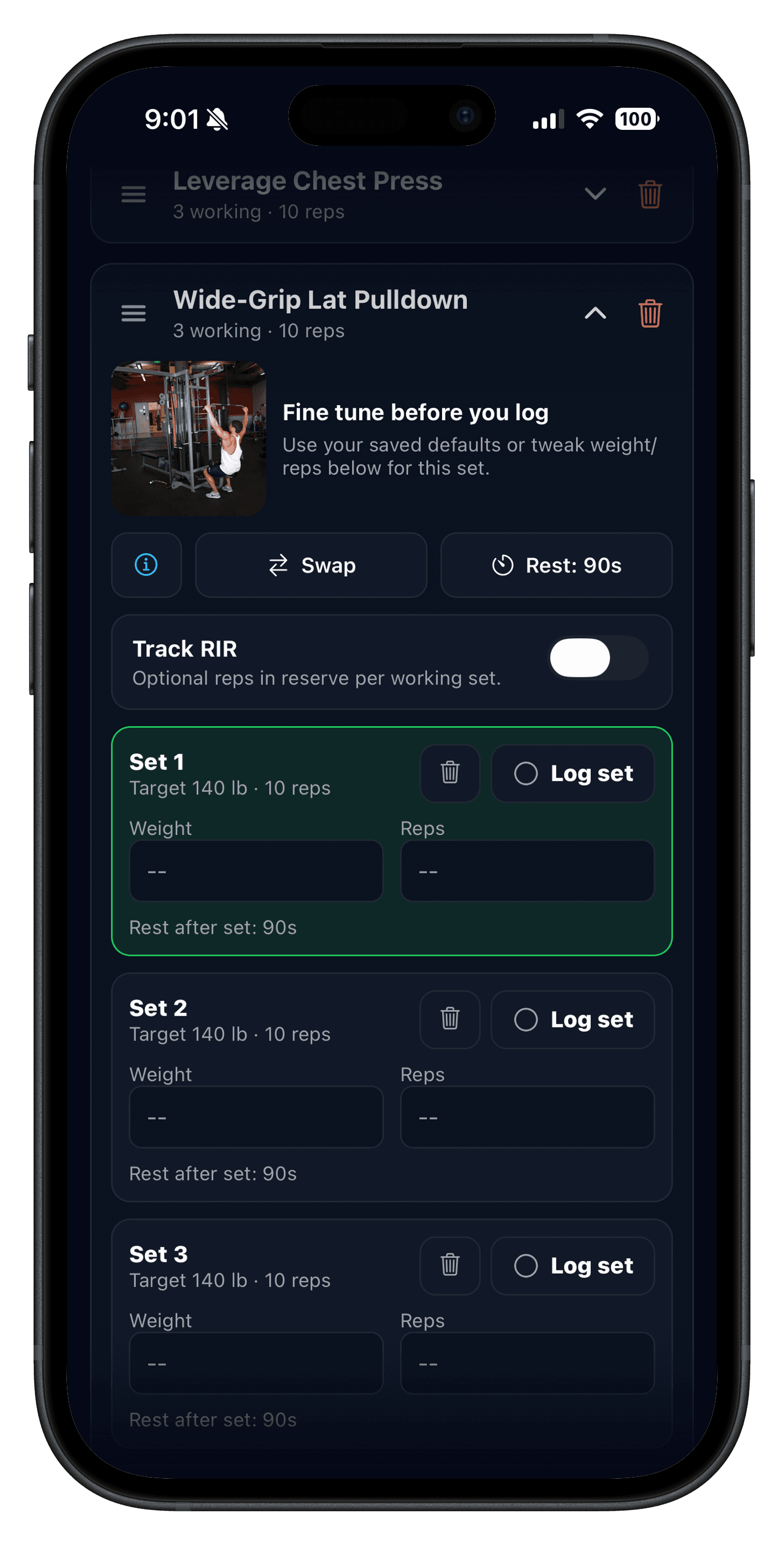
- Set an adjustable rest timer per exercise (working sets and warm-ups).
- Use previous workout values to match pacing and effort session to session.
- If you auto-regulate, log effort with RIR & RPE tracking so “hard sets” stay truly comparable.
A simple benefit of tracking rest the same way you track sets: when you beat your previous numbers, you know it is real progress—not just “I rested longer today.”
Sample rest setup (copy/paste)
Use this as a starting point and adjust based on how your sets look and feel. If you are consistently missing reps, rest more.
- Warm-ups: 60-90 seconds
- Working sets (3-8 reps): 2:30-4:00
- Working sets (8-12 reps): 1:45-3:00
- Working sets: 1:15-2:15
- Isolations (curls, lateral raises, triceps): 0:45-1:30
- Main lift: 2:00-3:00 (minimum), add 30 seconds if needed
- Superset accessories: 0:45-1:15 between paired exercises
- Keep total exercise count small and repeatable
Related reading
- Progressive Overload Explained: How to Get Stronger Without Overthinking Your Training
- Workout Log: Track Sets, Reps, and Weight Without Overthinking
- Workout Recovery: Should You Train Today? A Simple Readiness Checklist
- Workout Apps: How to Choose the Best Workout App for Your Training
Final takeaway
If you want stronger, cleaner progress, stop letting rest be random. Rest until you feel ready, then use a consistent timer as a guardrail. When your rest is stable, your log becomes a real feedback loop—and progress becomes obvious.
Track rest like you track sets
Push/Pull is a clean workout tracker app for iPhone with fast logging, templates, previous values, and an adjustable rest timer designed for real training.